


Many people safeguard their wealth by investing in gold, especially during times of economic or political uncertainty. Various price increases have resulted from the Trump administration’s global tariff announcements, highlighting gold’s stability when markets are in flux.
If you’re new to gold investing, this guide covers the essentials to help you get started. You’ll learn why this precious metal tends to hold its value in turbulent times, what to consider before investing and how to avoid beginner mistakes.
Why Should You Invest in Gold?
Though digital assets have recently dominated global headlines, gold remains a valuable asset to own. It is a safe haven for investments amid uncertainty and has become more accessible. Here are the primary reasons you should think about investing in gold as a beginner.
Diversify Your Portfolio
Gold prices can vary compared to traditional assets like stocks and bonds. That quality makes it a valuable diversification asset, particularly if you own a wider investment portfolio. Gold can remain steady or potentially rise even when the stock market drops, an appealing benefit for novice investors looking to maintain a balanced portfolio.
Protects During Poor Economic Times
During economic downturns, gold can still outperform other assets in financial markets and respond to changes in monetary policy. Due to its consistent performance, investors often choose gold to protect their wealth. Gold’s enduring value across centuries makes it a compelling long-term asset.
Safeguards Against Inflation
Inflation may reduce the value of your cash savings. However, gold may protect your portfolio from inflation because its value rises in tandem with the prices of consumer goods and services like fuel and food. Gold usually holds its value when prices rise because it is not as readily available as money.
Continuously Proves Its Value
Paper currency can lose its value due to inflation and economic downturns. In comparison, gold is a favorable investment option that maintains its status as a reliable store of value. Gold has been a precious commodity for thousands of years, and this history makes it a trustworthy investment opportunity for beginners.
Provides Security During Market Volatility
Gold is a universal investment across all countries and currencies. Therefore, it will likely maintain its purchasing power during financial crises and geopolitical instabilities. Gold’s reliability is a sound investment amid uncertainty, particularly if you are new to investing.
Exploring Your Gold Investment Options
You can invest in gold in several ways, including coins, bars, jewelry, stocks and funds. Flexible alternatives such as mutual funds, ETFs and digital platforms make it easy to include gold in your portfolio. Before settling, explore your options and decide which path, or combination, makes the most sense for you.

Gold Bullion, Bars and Coins
Investing in physical gold, also known as bullion, involves purchasing assets like gold coins or bars. You can buy bullion through banks, reputable dealers or online platforms, often at a premium above the current market price to account for production and distribution costs.
Buying bullion gives you a tangible representation of your investment. However, you’ll need to decide where and how to securely store your gold, such as a home safe or bank deposit box, and factor in the cost and logistics of insurance to protect your assets.
Mutual Funds and ETFs
Keeping tabs on the price of gold through ETFs and mutual funds allows you to invest in gold without owning physical gold bullion. ETFs, such as the iShares Gold Trust, are available to purchase. You can buy and sell ETFs with less money, making this option more approachable.
Stocks and Funds
You can also buy shares in companies that produce or mine gold or invest in mutual funds that hold a diversified range of stocks. The companies you invest in will generate further profit as gold prices increase. Be aware that gold stocks may be more volatile than the price of gold. Market trends, company performance and mining costs may affect your investment.
Jewelry
Jewelry is the most familiar way to invest in gold. Since it offers the dual benefits of being ornamental and valuable, you can usually expect to pay more than market value. Retail markups, craftsmanship and design costs all contribute to the higher price.
If you choose to invest in gold jewelry, pay close attention to its quality and authenticity. Look for documentation of each piece’s karat rating, weight and other identifying details, and remember to protect their value with storage and insurance.
Gold IRA
A gold individual retirement account is a unique way to plan for your golden years. Also known as a self-directed IRA, it allows you to make gold bullion and related investments part of your retirement savings fund. A gold IRA also offers specific tax advantages. It’s a way to diversify your retirement portfolio beyond traditional stocks and bonds, offering a hedge against inflation and market volatility. However, you may need to appoint a custodian to manage your account.
How to Invest in Gold as a Beginner
New investors are wise to develop a plan before diving straight into the gold investment market. Because gold comes in various forms, you should weigh your choices carefully to decide which investment type will work best for your portfolio.
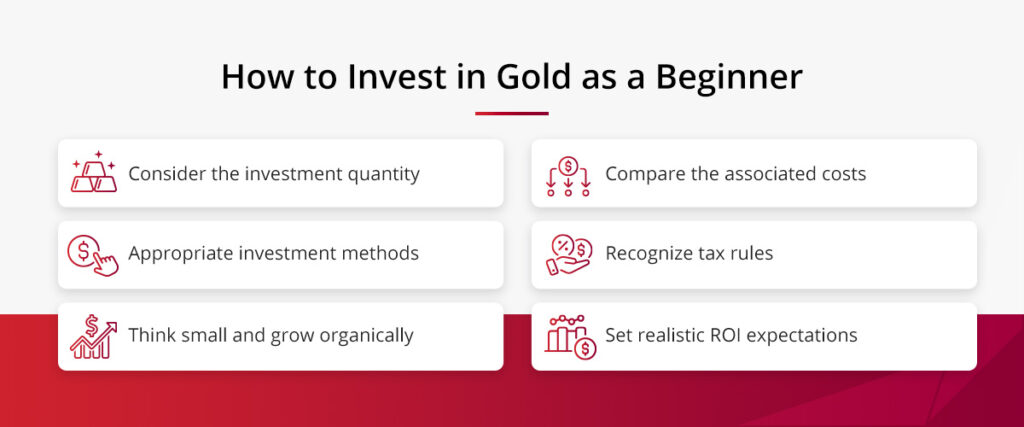
- Consider the investment quantity: How does gold fit into your financial goals? If you’ve never invested before, decide what portion of your portfolio you want to dedicate to gold, and why.
- Appropriate investment methods: Not all gold investment types are suitable for your portfolio. You may prefer gold bullion over ETFs and mutual funds to physically hold on to your investment. Think about what works best for you in the long term.
- Think small and grow organically: It’s a best practice to build an investment portfolio gradually, managing market timing as you go.
- Compare the associated costs: You should budget for storage and insurance if you prefer to buy gold bullion or jewelry.
- Recognize tax rules: Seek expert advice on the tax implications of various gold investments. For example, owning gold bullion and setting up a gold IRA have separate rules and regulations.
- Set realistic ROI expectations: Though gold is a comparatively stable investment, it is not risk-free. You may experience periods of minimal gain due to market fluctuations.
Common Mistakes With Gold Investment for Beginners
Investing in gold is an attractive opportunity. However, you should be aware of the potential pitfalls before taking the plunge.
- Investing all your savings: Despite its reliability as a solid investment, allocating your entire savings to gold is still a significant risk. Start investing small and work your way up to avoid potential financial difficulties.
- Not monitoring gold performance: With your busy schedule, you may forget to check your portfolio. While gold generally maintains its value, it may fluctuate slightly. Savvy investors continuously track gold performance so they can buy and sell at optimal times.
- Relying on a single source: Diversifying your investments instead of putting all your eggs in one basket can reduce risk and improve long-term stability. A diversified portfolio that includes funds and stocks will leave you less vulnerable to swing pricing.
- Expecting an instant ROI: Investing in gold is a long-range strategy, which means immediate returns are unlikely. Be patient.
- Overlooking storage: You must have secure storage before investing in gold bullion. A home safe can be practical for smaller amounts. For larger amounts, consider professional storage solutions to comply with insurance requirements.
- Misplacing your documentation: If you decide to sell your gold, you will need to provide documentation, including the purchase date, storage records, proof of authenticity and the weight and karat reading.
- Not checking seller credentials: Counterfeit gold is a widespread issue. Gold must be at least 10 karats, which is the legal minimum. Always purchase gold from reputable dealers who can provide evidence of authenticity and transparent pricing.
Gold Investment and Retirement Planning
Adding gold to your retirement portfolio can offer stability and protection against market volatility. One way to do this is through a gold IRA, a specialized account that lets you invest in physical gold with tax advantages. Setting up a gold IRA is straightforward, but you must choose an experienced custodian who complies with all IRS regulations. Consider the benefits of opening a gold IRA for your retirement.
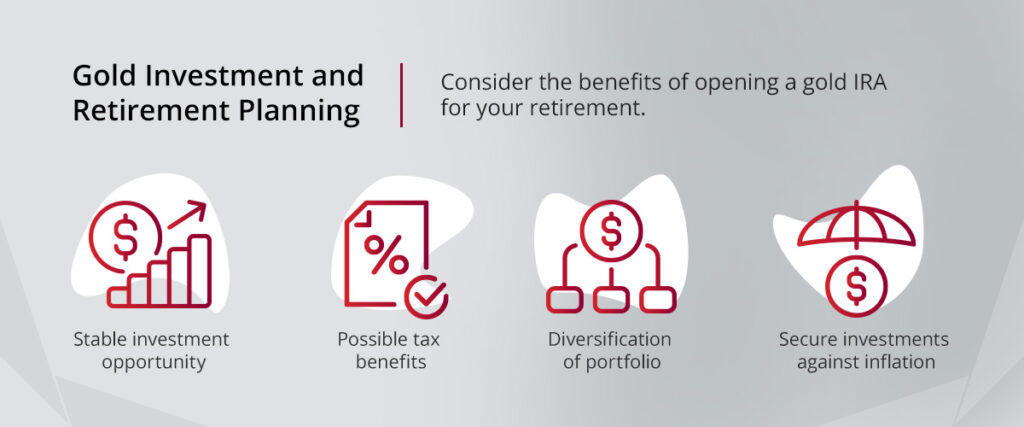
- Stable investment opportunity: Gold tends to hold its value even when markets are volatile, making it a reliable hedge against economic uncertainty.
- Possible tax benefits: If you decide to invest in gold outside a structured account, you could encounter tax problems when trying to sell it. However, investing in gold as part of an IRA provides the same tax advantages as other investments, such as real estate and stocks.
- Diversification for your portfolio: While stocks and bonds may be the first thing you think of when discussing investments, including gold is a wise way to diversify your portfolio and reduce your reliance on other sources. A mixed portfolio offers a steady balance to protect against geopolitical and financial crises.
- Secure investments against inflation: When the prices of fuel, groceries and other everyday essentials increase due to inflation, gold generally moves in the opposite direction. Putting gold into an IRA account allows you to insulate yourself from inflation.
Your Gold Investment Checklist
Are you ready to invest in gold? Use the checklist below to help you move forward strategically.
- Research the market and compare your investment options.
- Follow the news on world events and financial developments.
- Consider your reasons and objectives for investing in gold.
- Diversify your portfolio to protect against uncertainty.
- Ask a professional for their insights and modify the advice as needed.
- Think about the potential risks of gold investing.
- Factor in associated costs, such as storage and insurance for gold bullion.
- Be patient and strategic instead of making snap decisions.
Start Investing Today
When you want to explore gold investment opportunities, Accuplan Benefits Services offers a knowledgeable team of committed experts to help you with all elements of self-directed IRAs.
Our extensive understanding and passion for self-directed IRAs provide the reassurance you need when selecting the best account administrator for your retirement. Accuplan’s industry-leading team has decades of hands-on experience with IRS compliance, state and federal laws and self-directed 401(k) savings plans.
You can apply for a self-directed IRA in three steps. First, you will fill out your personal information with a form of ID, followed by the funding options for your account. Lastly, you will complete a Direction of Investment form via your account dashboard.
Contact our team today to learn more about how we can help you retire your way.

Ready to start?
Open a self-directed IRA today.
10-minute application. Real human support.